


"Since the Enlightenment, embodied knowledge creation has been overlooked, ignored, or disparaged as inferior to other forms of expression or thinking that seem to leave the material world behind. Making as embodied knowledge has been, in a word, gendered, rendering it as ostensibly inept" (Goggin & Rose, 2021, p. 4).
As we engage feminism and materialism through Conference Creatures, we are attuned to both "the rhetorical gendering of work" (Hallenbeck & Smith, 2012) and the ways in which work functions as a technology of gender (Weeks, 2011). Labor, in other words, produces gendered subjects and becomes gendered itself through those subjects' material-discursive productions.
In the case of fiber arts, like crocheting and knitting, rhetoricians who study material craft (Goggin, 2009; Goggin & Rose, 2021; Gruwell, 2022; Pristash et al., 2009) recognize that this work is gendered as feminine and usually racialized as white. Although men and women alike have always engaged in this work, fiber arts became feminized through the development of Western capitalism and the concomitant separation of production and reproduction (Goggin, 2009). Labor undertaken with the loom, the hook, and the needle was thus cast as "domestic" and therefore "less than" men's work.

In this way, we can understand fiber art as a form of feminized labor. As theorized by feminist compositionists (Holbrook, 1991; Schell, 1992), "women's work" or feminized labor not only receives less recognition than so-called "men's work," but it also tends to involve a higher degree of service, care, and emotional labor. For fiber arts, Leigh Gruwell (2022) noted that craft connotes both "romanticized" notions of domesticity and feminine "virtue" on the one hand, and "frivolity" on the other (p. 33). Craft's association with the affective and the material contributes to its feminization.
Like other forms of feminized labor, craft occupies the devalued pole of a host of binary constructions: masculine/feminine, art/craft, public/private, mind/body, mental labor/physical labor, work/leisure, theory/practice, product/process and production/reproduction (Goggin & Rose, 2021; Gruwell, 2022; Jubas & Seidel, 2016). As Maureen Daly Goggin (2009) explained, this has led to a dearth of scholarship on fiber arts, which further exacerbates the false assumption that women's craft does not produce knowledge worthy of study.
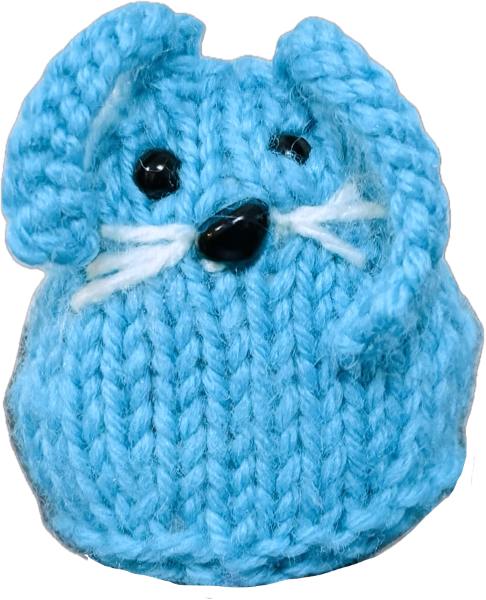
Through Conference Creatures, we challenge the denigration of craft as nonintellectual "women's work" separate from "men's work." We do not, however, aim to simply lay claim to the devalued elements of these binaries. While understandable, such a move would only uphold the divisions at the root of white supremacy, patriarchy, and capitalism. Instead, Conference Creatures knits both sides together. We recognize that all work, for example, is both intellectual and material. As we crochet, we interweave the intellectual and the embodied, the material and the social, the private and the public, the mind and the body.

In particular, we view creating through Conference Creatures as a means of materializing new relational possibilities by combining productive and reproductive labor. Defined by feminist theorist Kathi Weeks (2011), reproductive labor refers to the production and maintenance of "social and political subjects" (p. 8), work which is typically assigned to women. Reproductive labor includes domestic work, care work, and education (Hallenbeck & Smith, 2015; Weeks, 2011). Although this type of labor often upholds capitalist relations by generating ideal worker-citizens, Weeks located possibility within reproduction—specifically, within the "construction of subjects whose needs and desires are no longer as consistent with the social mechanisms within which they are supposed to be mediated and contained" (p. 100).
In understanding craft as one type of potentially subversive reproductive labor, we build on existing work on the radical potential of feminized craft to effect social change. As Goggin (2009) put it, crafters "produce and reproduce cultural objects as well as communicate and transform cultural values" (p. 3). Fiber arts have historically served as a medium for community-building (Goggin, 2009), protest (Gruwell, 2022), and subversive political action (Pristash et al., 2009). Today, scholars like Kaela Jubas and Jackie Seidel (2016) carry on these legacies by showing how knitting circles, for example, can push back against neoliberalism in academia. Thus, when we create Conference Creatures, we also create new ways of relating in the field that subvert tightly knotted systems of domination.