

In Weaving Connections, we discuss how Conference Creatures aims to intervene in our field's kairotic spaces, or the "less formal, often unnoticed, areas of academe where knowledge is produced and power is exchanged" (Price, 2011, p. 60) like group meals and conversations in between sessions at conferences. Recognizing that kairotic spaces too often exclude and alienate already marginalized academics, including especially BIPOC, disabled folks, and graduate students and junior scholars, we began Conference Creatures with the goal of transforming professional kairotic spaces toward inclusivity and accessibility.

In this section, we suggest—tentatively—that so far, Conference Creatures has indeed extended kairotic space. Here, we invoke dual meanings of "extend." Conference Creatures extends kairotic space, first, by inviting more scholars, including traditionally marginalized scholars, to participate in informal exchanges and community-building. Thanks to our digital presence, Conference Creatures also extends the fabric of kairotic space over a larger amount of space and time.
Our use of crochet as a method for creating more equitable kairotic spaces is apt, considering the historical associations of kairos with weaving (Gruwell, 2022; Jack & Duvall, 2024). Leigh Gruwell (2022) demonstrated how weaving draws our attention to "the rich sense of materiality that informs kairos" (p. 57). She elaborated: "In the act of weaving, then, we can see how kairos does not exist independent of the material actors that together constitute any rhetorical assemblage; rather, it both produces and is produced through those actors' varied intra-actions" (pp. 56–57). Applied to the concept of kairotic space, this materialist understanding of kairos suggests that participants in kairotic space—human and more-than-human alike—can, through their various entanglements, transform the kairotic space they inhabit.
Indeed, Jordynn Jack and Emma M. Duvall's (2024) reframing of kairos through weaving similarly turned toward its material and embodied dimensions. By examining the ancient relationship between kairos and the loom, Jack and Duvall redefined kairos as "a multidimensional judgment of what is 'just right,' neither too much or too little, and therefore what is appropriate in a given situation" (p. 60). Importantly, this understanding mitigates against the traditional, "masculinist sense of urgency" (p. 55) that accompanies kairos and replaces it with attention to "balance and due measure" (p. 65). Rather than simply referring to timeliness, then, kairos comes to encompass attention to ethics and rightful action.

If our field's professional spaces too often exclude marginalized and junior scholars, Conference Creatures aims to extend belonging. Here, we build on the work of researchers in disability studies like Ada Hubrig and Ruth Osorio (2020), who reminded us that "access necessitates more than the ability to simply enter a physical, digital, or textual space: access, rather, produces the conditions for all people to connect, create, and lead if they so choose" (p. 91). As Karen Tellez-Trujillo (2022) persuasively narrated, simply being accepted to a conference or entering a conference space does not equate to welcoming or belonging. Conference Creatures therefore takes up the active work of crafting belonging.
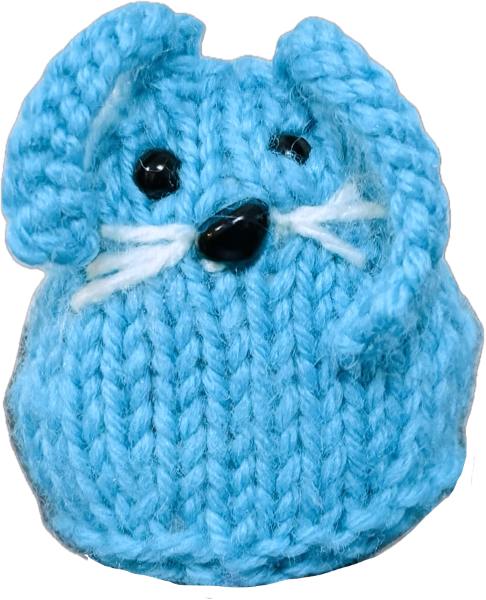
At conferences where we are present, everyone can receive a Conference Creature (until we run out!). It doesn't matter if attendees are celebrated authors, undergraduate students at their first conference, or employees at the conference venue—everyone is welcome to take a creature. In this way, Conference Creatures intentionally removes barriers to inclusion that structure so many other professional networks. We also make a concerted effort to cultivate belonging by giving each participant a short, printed note expressing our gratitude for participants. For example, the note we created for the 2025 Writing Innovation Symposium (WIS) read
Hello! You've encountered conference.creatures, an experimental project in new materialist feminist praxis. Your work in our community of writers and your presence here helps constitute the concept of mise en place for the 2025 Writing Innovation Symposium. You're exactly where you should be! Through conference.creatures, we aim to recognize, celebrate, and support your presence at field conferences by encouraging comfort and joy in these liminal spaces. We hope our experiment encourages you to think about making—of materials, ideas, feelings, relationships, food, etc.—as opportunities to foster community, collaboration, care, and relaxation.
This note and a crochet creature constitute, in truth, a small gesture toward inclusion. Conference Creatures on its own cannot solve the embedded systems of marginalization and exclusion that still structure many of our field's professional spaces. But we believe strongly in the importance and potential of small gestures to make change. Both Margaret Price (2011) and Tellez-Trujillo (2022) pointed to the impact of simple actions, like "friendly greetings" (Price, 2011, p. 137) and an invitation to dinner (Tellez-Trujillo, 2022, p. 10), on marginalized academics' professional trajectories. So far, we've found that Conference Creatures does make folks feel more welcome in professional spaces. Participants have told us that receiving a creature was "the best thing" they've experienced at an academic conference, and that their creature "made" the entire conference for them. With time, we hope that Conference Creatures can extend these feelings into larger professional networks that work to transform our field toward greater inclusion.
Conference Creatures aims to create new relationships and networks that center intersectional justice and belonging. On one level, our project facilitates networking in conference spaces. We encourage folks to have their creatures accompany them to presentations and other conference events, with the idea that creatures can be a great conversation starter. Two or more attendees might connect over each of their Conference Creatures, or an attendee who has not yet encountered our project might ask a participant why they have a little crochet creature sitting with them. In this way, creatures can spur discussions between participants who otherwise might have never spoken or introduced themselves.

We witnessed this type of networking begin at WIS 2025. After we gave participants creatures at the end of the first day of the conference, we were overjoyed to see creatures everywhere on the second day! Creatures sat in the audience, propped up against water bottles and notebooks; they perched on podiums and presenters' tables; and they ate lunch with participants. In that liminal, kairotic space before a conference presentation begins, participants chatted about their creatures, discussing why they chose the creature they did and sharing their new creatures' names.
Although these connections happened within the physical space of WIS, we hope that the digital component of our project—mainly our social media, but also, now, this webtext—can extend the Conference Creatures network over time and space, allowing participants' connections to last long beyond the conference. Here, we invoke what Leigh Gruwell (2022) referred to as "digital materiality" (p. 10), which recognizes the intertwined nature of the digital and the material, particularly in reference to craft. As Gruwell (2022) explained, digital materiality allows us to attend to how "digital spaces reflect and are reflected in 'real' (offline) life" (p. 82).
In the case of Conference Creatures, our social media presence requires a material referent (the creatures) to function. While we distribute creatures in physical conference spaces, their digital materiality facilitates opportunities for networking after a conference concludes. We've had multiple participants share photos with us of their creatures in different physical spaces and settings outside of and after the conference. Through posts like these, participants offer others a window into their lives that invites further connection. Engaging Conference Creatures on these digital platforms can help create a more tightly knit community. Further, two participants have let us know that they've begun learning how to crochet after interacting with our project! These examples demonstrate, for us, how our project encourages both digital and material connections.
Our recent appearance at the 2025 Digital Media and Composition (DMAC) Institute also illustrates how Conference Creatures refuses the supposed digital-material divide. DMAC operates fully remotely, meaning that participants tune into sessions from across the country. Thanks to generous support from DMAC staff, including especially John Jones and Sabrina Durso, we were able to ship creatures to every DMAC participant. During and after the institute, we heard from participants that receiving a creature allowed them to feel more connected to the DMAC community. This is a particularly important instance of digital-material community-building, for us, given the necessity of options for remote participation in professional spaces. Many academics, for financial, health, or other reasons, cannot attend conferences and other professional events in person. Here, Conference Creatures may be one way of extending conference kairotic spaces across space and time and toward greater inclusion.